Terraria in 2026: Still My 2D Minecraft-Castlevania-Zelda Obsession
Back in 2011, if you had told me a tiny indie team was about to release a game that could be accurately described as Minecraft plus Castlevania plus Zelda, I would have laughed, then checked my drink. But that is exactly what Terraria looked like: a two-dimensional sandbox where mining and building shared equal billing with combat, equipment, and enormous bosses. And somehow, in 2026, I am still playing it. So yes, I owe 2011 me an apology.
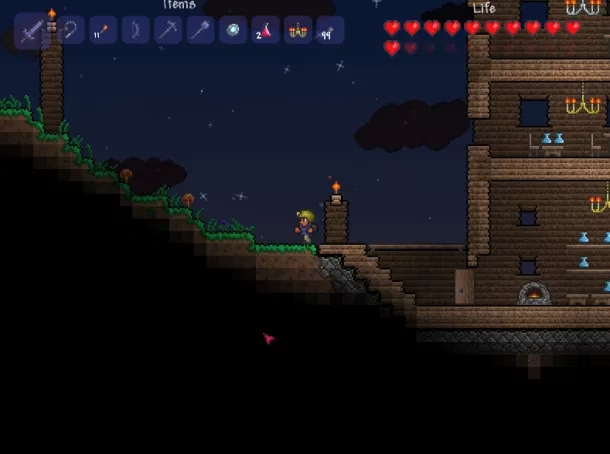
The original pitch was absurdly simple, and that is why it worked. I remember reading that Terraria would launch via Steam on Monday, May 16, 2011, for just $9.99. A tiny indie team. A 2D world. A game that looked like Minecraft had fallen into a gothic castle and picked up a sword. I was incredulous. Then I bought it. Then I lost a weekend, a month, and roughly a decade and a half of my free time. The original coverage promised more news soon, and here I am in 2026, still thinking about it.
| Influence | What it gave Terraria | What Terraria did with it |
|---|---|---|
| Minecraft | Blocks, mining, crafting, building | Turned it 2D, sped it up, and added actual combat |
| Castlevania | Gothic monsters, whips, dark castles | Boss fights that feel like a metal album cover |
| Zelda | Exploration, dungeons, loot | Infinite worlds, player freedom, and no princess waiting |
Let us be honest: Terraria is not just Minecraft in 2D. If Minecraft is a quiet Lego set with a creeper problem, Terraria is a Lego set that occasionally grows an eyeball the size of your house and tries to eat you. You dig, you craft, you build a nice little house. Then the Eye of Cthulhu shows up. Then the Eater of Worlds. Then Skeletron. Then the Wall of Flesh. Then the Moon Lord, who looks like Cthulhu's final form and fights like your keyboard owes him money.
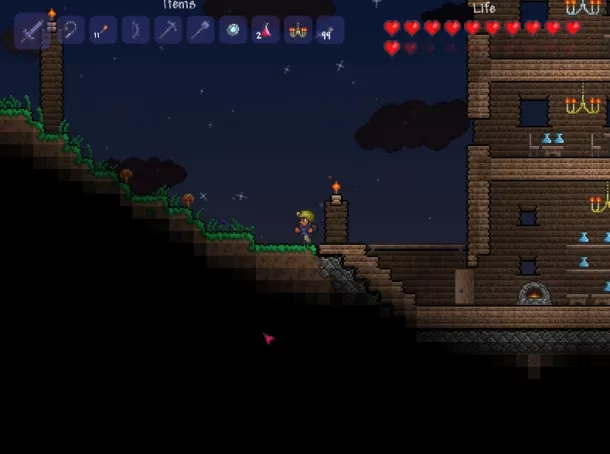
Combat and equipment are the real hooks. Swords, bows, guns, magic staves, summoner whips, grappling hooks, wings, mounts, and enough accessories to make a spreadsheet weep. Every boss drop unlocks a new way to break the game, and every new biome gives you another reason to say, just five more minutes, at 3 a.m. on a Tuesday. Is that healthy? No. Is it glorious? Absolutely.
Now, in 2026, the original $9.99 price feels like a prank. Terraria has outlived countless big-budget live-service games that launched with roadmaps and died with apologies. It still gets updates. It still has a massive modding scene. It still runs on a potato. It still has fishing, golf, a Bestiary, NPC happiness, and a community that will happily explain why your house is invalid because you forgot a chair. The long-promised 1.4.5 update has been the community's white whale for years, and whether you have already harpooned it or are still waiting, the game's habit of reinventing itself is the point.
Would I recommend it to a new player in 2026? Yes, with the enthusiasm of a slime that just found a shiny copper coin. Start a world. Chop a tree. Build a box. Dig too deep. Summon a boss you are not ready for. Die. Respawn. Learn. Repeat. That loop is still one of the purest joys in gaming.
Tiny indie team? Re-Logic is not tiny in reputation anymore, but the game still feels handmade. It is a combination that should not work: 2D Minecraft, Castlevania combat, Zelda exploration. Yet it does. It is refreshing, ridiculous, and endlessly replayable. And if you told me in 2026 that a tiny indie team was about to release a game like that, I would still be incredulous. Then I would check the price, see $9.99, and clear my calendar.
Final question: if a tiny indie team can make a game that combines Minecraft, Castlevania, and Zelda, and it still holds up in 2026, what is your excuse for not playing it? I will be over here, mining chlorophyte and pretending I can stop anytime.