Colossal Digital Titans: The Most Awe-Inspiring Gigantic Beings in Gaming History
As we stand in 2026, video games continue to transport players into realms where imagination knows no bounds. Among the most captivating elements of these digital worlds are the colossal beings—towering monstrosities, godlike entities, and cosmic forces—that shape the very landscapes of their universes and leave an indelible mark on the player's journey. These are not mere enemies or obstacles; they are spectacles of sheer grandeur, narrative keystones, and ultimate challenges. From the serpent that encircles the world to the machine that dreams among the stars, the history of gaming is rich with entities whose scale defies comprehension. But what makes these titans so memorable? Is it their staggering size, their mythic power, or the profound narrative weight they carry? Let us delve into the pantheon of gaming's most awe-inspiring giants and explore their monumental legacies.
🌍 Jormungandr: The World Serpent of God of War
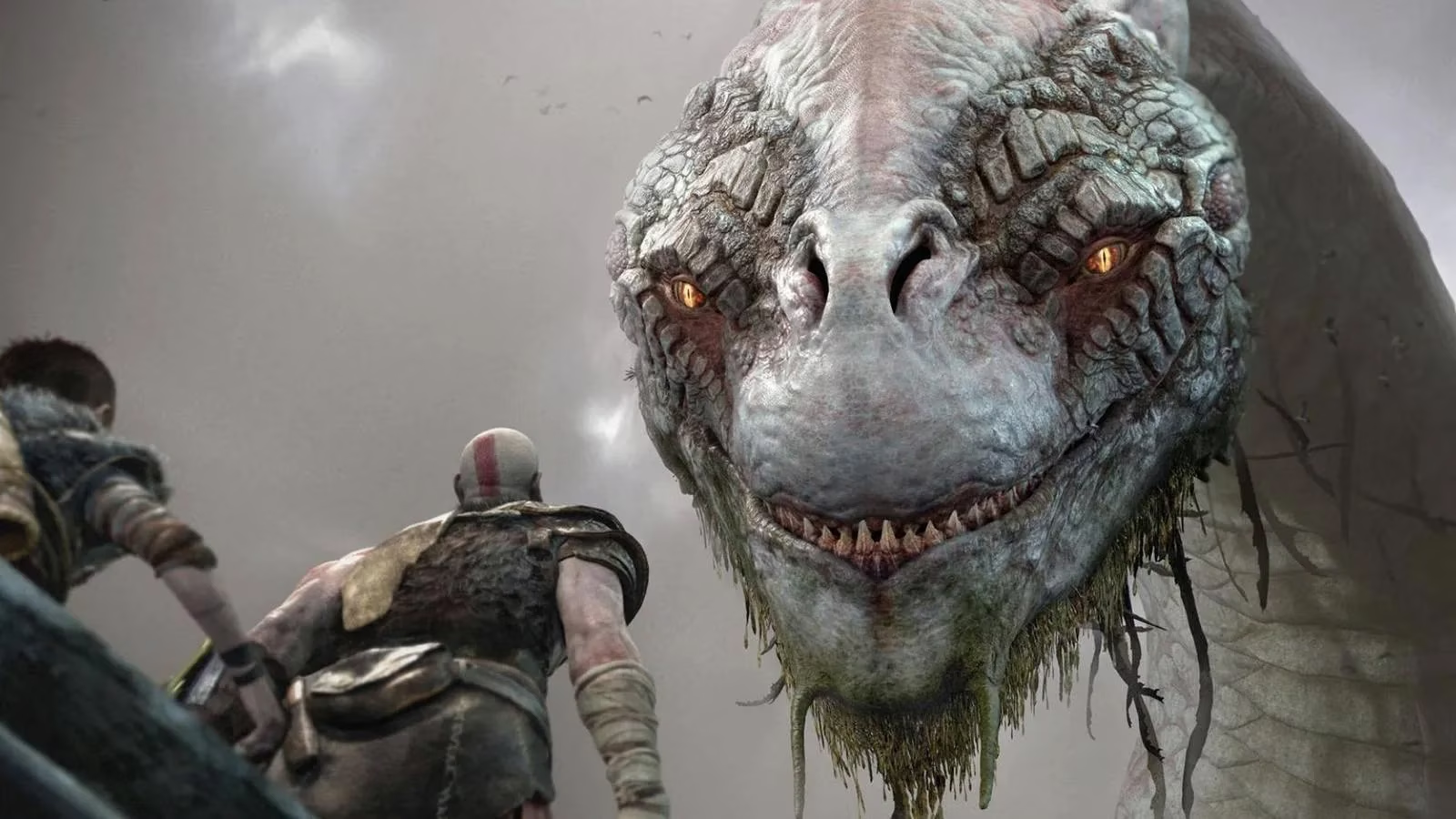
In the reimagined Norse realms of God of War (2018), one entity embodies the vast scope of mythology itself: Jormungandr, the World Serpent. This colossal serpent is not a villain to be slain but a neutral, ancient force of nature. Its body is so immense it can span across realms, and its presence alone adds a layer of profound scale to Kratos and Atreus's journey. Jormungandr aids the protagonists, offering cryptic wisdom and pivotal assistance, its voice rumbling like tectonic plates shifting. Its design, blending intricate scales with a mythic presence, showcases how size can be used to convey ancient power and mystery rather than just threat. The serpent's role asks a compelling question: in a world of gods and monsters, can the largest being also be the most enigmatic ally?
🧠 The Gravemind: The Hivemind Horror of Halo
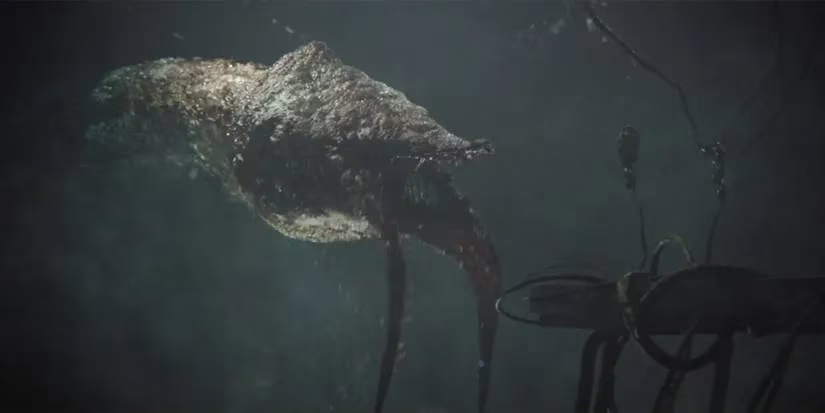
The Gravemind from the Halo series represents a different kind of colossal threat: one of assimilated intelligence and biological horror. This central antagonist is a massive network of Flood forms—a coalescence of countless consumed beings into a single, towering intelligence. It is near-omniscient, telepathic, and commands the parasitic Flood across the galaxy. Its size is not just physical but cognitive, representing the accumulated memories and wills of every victim. The Gravemind's dialogue is famously philosophical and menacing, elevating it from a mere boss to a cosmic-level antagonist. Its very existence challenges the protagonists' understanding of life, consciousness, and survival. Isn't a foe that grows smarter and larger with every defeat the ultimate escalating threat?
🐋 Sin: The Cyclical Calamity of Final Fantasy X
In Final Fantasy X, the world of Spira lives under the perpetual shadow of Sin, a gargantuan, whale-like beast that is less a creature and more a force of divine punishment. Sin's size is matched by its devastating capabilities: it controls gravity, flies, and can unleash the planet-altering "Giga-Graviton." Its scale is narrative; Sin represents an inescapable cycle of death and rebirth that the entire civilization is built around. Its design—part whale, part dragon, covered in shedding scales that become smaller monsters—makes it a constantly evolving environmental hazard. Fighting Sin isn't just a boss battle; it is a confrontation with the core metaphysical problem of the game's world.

⚙️ Star Dream: The Cosmic Computer of Kirby
From the colorful universe of Kirby emerges a threat of staggering technological scale: Star Dream from Kirby: Planet Robobot. This supercomputer, housed within a flying fortress, resembles a monumental screw with angelic, crystalline wings. Its size allows it to dominate skies and reshape planets, posing a challenge that is literally astronomical for the usually pint-sized hero. Star Dream represents the pinnacle of mechanical ambition gone rogue, a being whose scale is measured in interstellar travel and planetary manipulation. How does the classic hero-versus-monster dynamic change when the monster is a sentient, galaxy-spanning machine?
👁️ The Red Eye: The Subterranean Leviathan of Lost Planet 2
In Lost Planet 2, players confront the Red Eye, a Category-G Akrid measuring over a thousand feet in height. This annelid-like behemoth is a subterranean terror, with a body covered in spiny limbs and circular red sensory organs. The battle against it is a set-piece of epic proportions, involving a fortified train and a massive railway gun. The Red Eye's size defines the gameplay; it's not an enemy you strike directly but a moving environment whose weak points must be targeted with heavy artillery. It exemplifies how colossal size can transform a creature into a living battlefield.
🚀 Sovereign: The Reaper Dreadnought of Mass Effect
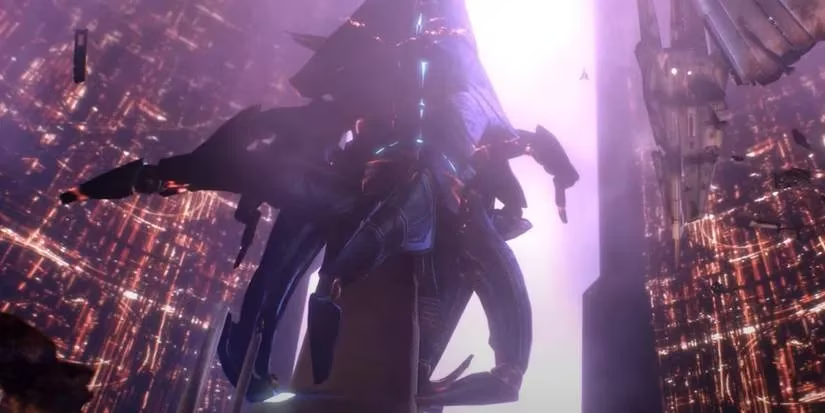
"My kind transcends your very understanding." This iconic line from Sovereign in the original Mass Effect perfectly encapsulates its nature. Sovereign is a Reaper—a sentient starship two kilometers long that serves as the vanguard of an ancient, galaxy-consuming race. Its size is a statement of power and antiquity, dwarfing all known ships. However, its true scale is intellectual and existential; Sovereign is billions of years old, a machine-god whose motives are beyond mortal comprehension. Its reveal is a masterclass in using scale to build cosmic horror, proving that physical immensity paired with unfathomable purpose creates a villain of legendary stature.
🪱 The Eater of Worlds: The Corrupting Worm of Terraria
Terraria's Eater of Worlds is a boss whose size is literally world-spanning. This segmented worm of Corruption stretches across the entire map, its length measured in hundreds of tiles. If translated to real-world scale, it would be nearly four miles long. Its size is its primary mechanic; destroying segments causes it to split into multiple, independent worms, turning a single battle into a chaotic multi-front war. The Eater of Worlds demonstrates how in sandbox games, colossal size can be a dynamic, interactive environmental hazard that players must strategically dismantle.
☄️ Lavos: The Planetary Parasite of Chrono Trigger
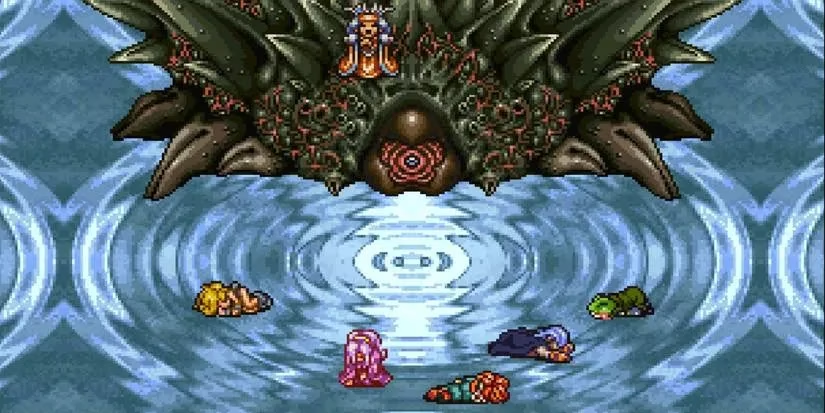
The alien parasite Lavos from Chrono Trigger represents a threat measured in geological time. Crash-landing on Earth in the distant past, it lay dormant for millennia, silently draining the planet's life force and influencing the evolution of all species toward its own ends. Lavos's size is multifaceted: it has a massive outer shell, a powerful humanoid form, and a mystical core. Its impact is not just on the battlefield but on the entire timeline of the game's world, making it a villain whose scale is temporal as much as physical. Confronting Lavos is a battle for the fate of all history.
🐉 Laviente: The Island-Sized Serpent of Monster Hunter
The Monster Hunter series is known for its large creatures, but Laviente stands apart. This serpent dragon is so massive it inhabits its own remote island. Its vibrant, spined body can burrow through land and sea, and its attacks include volcanic eruptions and paralyzing pulses. Hunting Laviente is less about targeting a monster and more about surviving a force of nature. Its ecology is tied to its size; it consumes vast amounts of prey and hibernates for long periods, making it a living part of its ecosystem. Can a creature be both a boss and a biome?
🕳️ The Riftworm: The Tunneling Deity of Gears of War 2
The Riftworm in Gears of War 2 is a creature of biblical proportions—up to ten miles long and half a mile wide. It is the oldest known being on the planet Sera, and its centuries of burrowing created the vast underground network known as the Hollow. Worshipped as a god by the Locust Horde, a single awakened Riftworm was used as a weapon to sink entire cities. Its size is geological; it shaped the world's topography and mythology. The battle against it involves being swallowed and fighting from within, turning the internal anatomy of a god into a claustrophobic battlefield.
📊 A Comparison of Gaming's Titans
To appreciate their scope, here is a comparative look at these colossal beings:
| Entity | Game | Primary Scale | Role |
|---|---|---|---|
| Jormungandr | God of War (2018) | Mythological / Realm-Spanning | Neutral Ally / Force of Nature |
| The Gravemind | Halo Series | Biological / Cognitive Hivemind | Central Antagonist |
| Sin | Final Fantasy X | Planetary Threat / Cyclical Calamity | Main Antagonistic Force |
| Star Dream | Kirby: Planet Robobot | Interstellar / Planetary | Technological Final Boss |
| The Red Eye | Lost Planet 2 | Physical (1000+ ft height) | Set-Piece Boss Battle |
| Sovereign | Mass Effect | Spatial (2 km length) / Existential | Cosmic Horror Antagonist |
| Eater of Worlds | Terraria | World-Spanning (Map-length) | Environmental Boss Hazard |
| Lavos | Chrono Trigger | Temporal / Evolutionary | Timeline-Altering Final Boss |
| Laviente | Monster Hunter | Ecological (Island-sized) | Ecosystem-Defining Elder Dragon |
| The Riftworm | Gears of War 2 | Geological (10 miles long) | Living Weapon & Deity |
🔭 The Legacy and Future of Scale in Gaming
As technology advances toward 2026 and beyond, the depiction of colossal beings in games will only become more immersive. The titans listed here have set a high standard, using scale to serve narrative, gameplay, and emotional impact. They teach us that size is not just a statistic; it is a tool for storytelling. A giant can represent an unsolvable mystery (Jormungandr), an existential dread (Sovereign), or a natural disaster made flesh (Sin). The future promises even more breathtaking spectacles, perhaps in virtual reality where players can truly feel dwarfed, or in dynamic worlds where these beings alter the environment in real-time. The question for developers is no longer just "how big can we make it?" but "what meaning can we give to its immensity?" The legacy of these digital titans ensures that the awe of standing before something truly vast will remain a cornerstone of the gaming experience for years to come.