Blooms of Peril: A Gamer's Encounter with Video Game's Most Dangerous Flowers
As I traverse the digital landscapes of my favorite games, I've come to appreciate the inherent duality of nature's beauty. For years, flowers have been symbols of innocence, love, and peace in our art and stories. Yet, in the hands of skilled game developers, these delicate blossoms are masterfully subverted into sources of genuine terror and formidable challenge. There's a unique thrill in confronting something so universally beloved that has been twisted into a menace. In 2026, looking back at gaming's history, this tradition of floral fright remains as potent as ever. The contrast between their lovely appearance and lethal function creates a memorable dissonance that sticks with me long after I've put down the controller. It's a testament to game design that something as simple as a petal or a vine can get my heart racing.
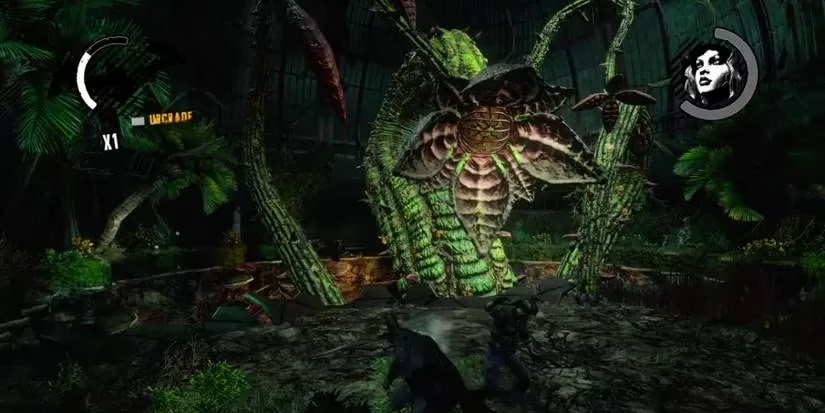
My first unforgettable encounter with a dangerous bloom was in the shadowy halls of Batman: Arkham Asylum. Poison Ivy is no delicate wallflower; she is a force of nature personified. I remember the palpable shift in atmosphere upon entering the Botanical Gardens. The air grew thick, and the usual gothic architecture gave way to an organic, pulsating nightmare. The genetically modified vines weren't just scenery; they were active hunters, snaking toward me with predatory intent. The boss fight itself was a spectacle of bio-horror. Confronting Ivy merged with that massive, red flowerhead felt like battling the heart of the jungle itself. Her safe haven within the flower's center, while monstrous tendrils lashed out, created a frustrating and brilliant tactical puzzle. It taught me that in these worlds, beauty is often just a prelude to danger.
Then there are the tools that bite back. The Bomb Flower from The Legend of Zelda series is a perfect example of high-risk, high-reward gameplay. I've relied on them countless times to blast open secret passages or clear rooms of enemies. But that reliance comes with constant tension. The moment Link plucks one from the ground, the fuse is lit. I've lost count of how many times I've fumbled a throw or misjudged the timer, resulting in an explosive and embarrassing defeat. Their infinite respawn capability means the threat—and the utility—is always present. They're a lesson in precision and timing, a beautiful bloom that demands respect.

Not all threats are loud or violent. In Season: A Letter to the Future, I found a more subtle, psychological danger. The Memory Flowers of that game are hauntingly beautiful. Fields of soft, pink light ripple in the wind, inviting exploration. But as Estelle, I learned their secret. Walking among them, my vision would warp and distort, a clear sign of their overwhelming psychic power. My pendant's protective glow was the only thing standing between me and having my memories, my very sense of self, consumed by their passive aura. It was a powerful narrative device: the most serene landscape hiding a potentially soul-crushing hazard. It made me question every beautiful thing I encountered in that world.
The Resident Evil franchise has built its legacy on corrupting the familiar, and Plant 43 from Resident Evil 2 is a prime specimen. The concept alone is chilling: an ordinary plant injected with the T-Virus, mutating into a factory for plant-zombie hybrids. I remember the dread of exploring the ruined laboratory, knowing the corpses of Umbrella scientists were reanimated by this floral abomination. Fighting the zombies was one thing, but the knowledge that a single, mutated root system was the source of it all created a deeply unsettling atmosphere. It wasn't just a monster; it was an ecosystem of death.
 .jpg?q=50&fit=crop&w=825&dpr=1.5)
My time in Terraria's hardmode taught me to fear pink petals. Plantera lulls you into a false sense of security. It appears as a large, pretty, slow-moving bulb. Engaging it, however, triggers a storm of seeds and thorny projectiles. The real horror begins at half health. The lovely pink exterior literally breaks apart, revealing a monstrous set of gnashing jaws and a fury of whipping vines. It's a classic bait-and-switch, a boss fight that evolves from a cautious dance into a frantic battle for survival. The transformation is a brilliant piece of design that perfectly encapsulates the theme of dangerous beauty.
-
Castlevania's Man-Eating Flowers: These fiery, Demogorgon-like blooms are relentless. Their ability to shoot fireballs, seeds, and even petrifying skulls while exhaling a poisonous breath makes them a multi-faceted threat in any corridor of Dracula's castle.
-
Flaahgra from Metroid Prime: A flower mutated by the planet-destroying Phazon into a colossal sun-devouring beast. The fight in the Sunchamber is a race against time, forcing me to solve the puzzle of stealing its sunlight while dodging toxic sprays and scything claws.
And then, there's Flowey. No discussion of dangerous flowers is complete without the sadistic little sunflower from Undertale. His initial greeting—a cheerful "Howdy!"—is one of gaming's greatest deceptions. That first encounter, where his "Friendliness Pellets" are anything but, is a masterclass in subverting player expectations. Flowey's philosophy is pure, distilled menace: kill or be killed. His boss battle, where he transforms into a grotesque, screen-filling abomination, is a psychological and mechanical assault. He breaks the fourth wall, he taunts, he saves and reloads the game against you. Flowey isn't just a dangerous flower; he's a manifestation of corrupted player agency itself, making him arguably the most terrifying bloom of all.
Reflecting on these experiences, I see a common thread. These games use our inherent affection for flowers as a foundation to build fear, challenge, and narrative depth. The danger is amplified precisely because of the source. A demon is scary; a demon that looks like a rose is unsettling on a deeper level. As gaming continues to evolve into 2026 and beyond, I have no doubt that developers will keep finding new, ingenious ways to make us think twice before stopping to smell the digital roses. The most beautiful gardens, it seems, often have the deadliest thorns.